Moving tips
Moving house with a cat: how to do it without losing them
Dogs move with their people. Cats move with their territory, and you are taking the territory away. That one difference explains every piece of advice in this guide — and why the cats that go missing after a move are usually the ones nobody planned for.
Why cats are different
A cat's sense of safety is built on a map: the routes, the smells, the places it can retreat to. Moving erases the map in an afternoon. A confident cat treats the new house as a puzzle; an anxious one treats it as a threat and looks for the way back to the old one. Everything below is about shrinking the change to something the cat can absorb — one room, then the house, then the outside — and keeping the cat physically contained until it has redrawn the map.
Two weeks before
- Get the carrier out now and leave it open in a room the cat likes, with a blanket in it. A carrier that only appears on vet days is a trap; one that has been furniture for a fortnight is a den.
- Check the microchip details you have on file, and find out which database the chip is registered with. You will be updating it on moving day.
- Book a vet check if there is anything outstanding — vaccinations, a flea treatment — so you are not finding a new vet in the first week for something avoidable.
- If your cat is nervous, a plug-in pheromone diffuser in the room it spends most time in can take the edge off the packing weeks. Ask your vet which they suggest.
- Keep feeding times, play times and the cat's usual spots as normal as you can while the boxes multiply. Pack the cat's room last.
- Decide the safe room at the new house now — a small room with a door, ideally not the kitchen, that will not be needed on moving day.
The day before and the day itself
- The night before, shut the cat in one room at the old house with its bed, litter tray, water and food, and put a sign on the door. Removal crews open every door; a sign stops the one that matters.
- Tell the crew there is a cat and which room it is in. Good firms ask; tell them anyway.
- Feed lightly on the morning — a full stomach and a car do not mix.
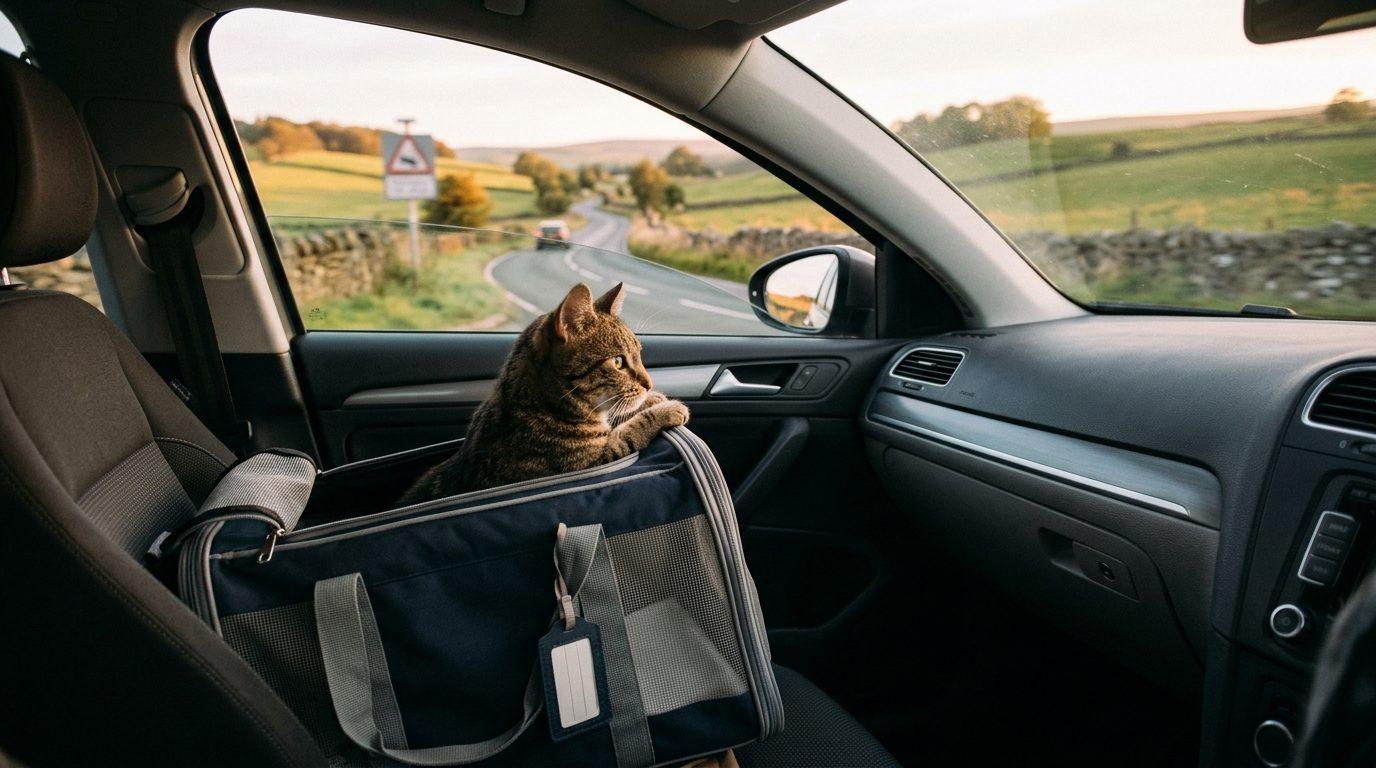
- The cat travels in the carrier, in the passenger compartment, with the seatbelt through the handle. Never in the boot, never loose, and never let out of the carrier at a service station, however much it complains.
- The cat is the last thing to leave the old house and the first thing into the new one, straight into the safe room — before the crew starts carrying furniture past the door.
Long-distance moves
For a drive of several hours, line the carrier with something absorbent, offer water at stops without opening the carrier fully, and accept that most cats will not eat or use a tray in a moving car. An overnight stop means the cat comes into the room with you, carrier opened only once the door is shut. If you are flying or crossing to Northern Ireland or the islands, the carrier requirements are set by the operator — check them weeks ahead, not days.
The first evening in the new house
Set up the safe room before you open the carrier: litter tray in one corner, food and water in another, the cat's own bed or an unwashed blanket that smells of the old house. Open the carrier and leave. Some cats come out in a minute; some stay under the bed until midnight. Both are fine. Visit quietly, sit on the floor, let the cat come to you. Do not carry it out to show it the house.
Keep the cat in — for longer than feels reasonable
At least two weeks indoors is the usual advice, and many vets say three or four for a nervous cat or one that has moved before and bolted. This is the part people skip, and it is the part that decides whether the cat is still yours in a month. Let it out of the safe room into the rest of the house after a couple of days, once it is eating and using the tray normally. Keep every external door and window shut, and warn everyone who visits.
The first time outside
- Choose a quiet time, before a meal, so the cat is hungry and has a reason to come back.
- Go out with it, leave the door open, and stay in the garden. Ten minutes is plenty the first time.
- Build up over a week. Call it in for food each time so the call means something.
- A microchip cat flap, if you are fitting one, keeps the neighbours' cats out of a house that does not smell like anyone's territory yet.
Update the microchip on moving day
In England, cats over twenty weeks old must be microchipped by law, and the details on the database have to be kept up to date — the chip is worthless if it points to your old address and a phone number you have stopped using. Log in to the database the chip is registered with (the paperwork from the vet or the rescue says which) and change the address on moving day. It takes five minutes and is the single most effective thing you can do for a cat that goes missing.
If your cat goes missing
- Check the old house first. Cats that get out early very often go back, especially on a local move. Ask the new occupants to look and to call you rather than feeding it.
- Tell the microchip database it is missing, so a scan at any vet or rescue flags it immediately.
- Put its used litter, or an unwashed piece of your clothing, outside the new house. Scent carries further than a voice.
- Search at dusk and dawn, calling quietly, and look under things — sheds, cars, decking. A frightened cat hides rather than runs.
- Ask neighbours to check garages and sheds, and put a photo on the local online groups.
Indoor cats, several cats, and the removal crew
An indoor cat moves the same way, minus the outdoor stage — but still needs the safe room and the slow release into the house, because the house is the whole world. Several cats go into the safe room together if they get on, separately if they do not; the move is not the time to renegotiate the hierarchy. And when you request removal quotes, mention the cat: a firm that knows will plan around a shut door instead of finding out from the inside of it.
Compare removal quotes — vetted firms price the same move — tell them about the cat on the formMoving with pets, in general — dogs, small animals and the paperworkQuestions people ask
How long should I keep my cat indoors after moving house?
At least two weeks is the usual advice, and three or four for a nervous cat, a cat that has moved before and bolted, or a move within a couple of miles of the old house. Let it out for the first time hungry, before a meal, and go out with it.
Should I let my cat explore the whole house straight away?
No. One small room first — bed, litter tray, food, water, a shut door — until it is eating and using the tray normally, usually a day or two. Then the rest of the house with the outside doors shut. A whole strange house at once is more than most cats can take in.
Will my cat go back to my old house?
It can, especially on a local move and especially if it gets out early. Ask the new occupants to call you if they see it, not to feed it. Keeping the cat in for the full fortnight or more is what prevents this.
Do I have to update my cat's microchip when I move?
Yes. In England microchipping is compulsory for cats over twenty weeks, and keeping the registered details current is part of that. Everywhere in the UK it is the single most useful thing you can do: a chip that points to the old address does not bring the cat home.
How do I move a cat a long distance?
In a secure carrier in the passenger compartment, with something absorbent in the base, water offered at stops without letting the cat out, and no expectation that it will eat or use a tray in the car. For an overnight stop the cat comes into the room with you. Check any ferry or airline rules weeks ahead.
Can a removal company move my cat?
No — pets travel with you, not in the van. Tell the firm there is a cat and which room it is shut in, and put a sign on the door. A good crew will work around it.
Ready to move?